
Sunday, July 7, 2013
Plumeria
Plumeria is related to the Oleander, Nerium oleander, and both possess an irritant, rather similar to that of Euphorbia. Contact with the sap may irritate eyes and skin. Each of the separate species of Plumeria bears differently shaped, alternate leaves with distinct form and growth habits. The leaves of P. alba are quite narrow and corrugated, whereas leaves of P. pudica have an elongated shape and glossy, dark-green color. P. pudica is one of the everblooming types with non-deciduous, evergreen leaves. Another species that retains leaves and flowers in winter is P. obtusa; though its common name is "Singapore," it is originally from Colombia.


Thursday, July 4, 2013
Erica (Heathers)
Erica


Erica is a genus of approximately 860 species of flowering plants in the family Ericaceae. The English common names "heath" and "heather" are shared by some closely related genera of similar appearance. The genus Calluna was formerly included in Erica – it differs in having even smaller scale-leaves (less than 2–3 mm long), and the flower corolla being more divided into separate petals. Erica is sometimes referred to as "winter (or spring) heather" to distinguish it from Calluna (summer (or autumn) heather)
Most of the species are small shrubs from 20–150 cm (8–59 in) high, though some are taller; the tallest are E. arborea (tree heath) and E. scoparia (besom heath), both of which can reach up to 7 m (23 ft) tall. All are evergreen, with minute needle-like leaves 2–15 mm long. Flowers are sometimes axillary, and sometimes borne in terminal umbels or spikes, and are usually outward or downward facing. The seeds are very small, and in some species may persist in the soil for decades.
Habitat
At least 660 of the species are endemic to South Africa, and these are often called the Cape heaths, forming the largest genus in the fynbos. The remaining species are native to other parts of Africa, Madagascar, the Mediterranean and Europe.
Like most Ericaceae, Erica species are mainly calcifuges, being limited to acidic or very acidic soils. In fact the term "ericaceous" is frequently applied to all calcifuges, and to the compost used in their cultivation. Soils range from dry, sandy soils to extremely wet ones such as bog. They often dominate dwarf-shrub habitats (heathland and moorland), or the ground vegetation of open acidic woodland.
Cultivation
Erica species are grown as landscape or garden plants for their floral effect. They associate well with conifers and are frequently seen in planting schemes as massed groundcover beneath varieties of dwarf conifers. They are capable of producing flower colour throughout the year. They can also be grown in tubs or window boxes to provide interest through autumn and into winter.
Cassiope (Heathers)
Cassiope
Kingdom: Plantae
(unranked): Angiosperms
(unranked): Eudicots
(unranked): Asterids
Order: Ericales
Family: Ericaceae
Genus: Cassiope
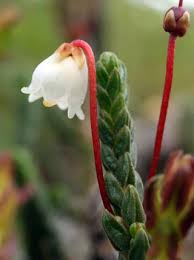
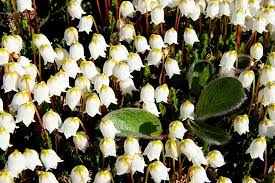
Cassiope is a genus of 9-12 small shrubby species in the family Ericaceae. They are native to the Arctic and north temperate montane regions. The genus is named after Cassiopeia of Greek mythology. Common names, shared with several other similar related genera, include heather and heath. They have scale-like leaves lying against the stems, and produce solitary bell-shaped flowers in late Spring. Though hardy, flowers can be damaged by late frosts.
They are cultivated in gardens, suitable sites being rock gardens, peat banks or glades in woodland areas. The hybrid cultivar 'Randle Cook' has gained the Royal Horticultural Society's Award of Garden Merit.



Kingdom: Plantae
(unranked): Angiosperms
(unranked): Eudicots
(unranked): Asterids
Order: Ericales
Family: Ericaceae
Genus: Cassiope
Cassiope is a genus of 9-12 small shrubby species in the family Ericaceae. They are native to the Arctic and north temperate montane regions. The genus is named after Cassiopeia of Greek mythology. Common names, shared with several other similar related genera, include heather and heath. They have scale-like leaves lying against the stems, and produce solitary bell-shaped flowers in late Spring. Though hardy, flowers can be damaged by late frosts.
They are cultivated in gardens, suitable sites being rock gardens, peat banks or glades in woodland areas. The hybrid cultivar 'Randle Cook' has gained the Royal Horticultural Society's Award of Garden Merit.
Tuesday, June 4, 2013
Roses

Roses


Species
Banksianae - white and yellow flowered roses from China.
Bracteatae - three species, two from China and one from India.
Caninae - pink and white flowered species from Asia, Europe and North Africa.
Carolinae - white, pink, and bright pink flowered species all from North America.
Chinensis - white, pink, yellow, red and mixed-color roses from China and Burma.
Gallicanae - pink to crimson and striped flowered roses from western Asia and Europe.
Gymnocarpae - one species in western North America (Rosa gymnocarpa), others in east Asia.
Laevigatae - a single white flowered species from China
Pimpinellifoliae - white, pink, bright yellow, mauve and striped roses from Asia and Europe.
Rosa (syn. sect. Cinnamomeae) - white, pink, lilac, mulberry and red roses from everywhere but North Africa.
Synstylae - white, pink, and crimson flowered roses from all areas.


Friday, May 17, 2013
Tuesday, May 14, 2013
Calluna (Heathers)


Calluna (Heathers)
Calluna vulgaris (known as common heather, ling, or simply heather) is the sole species in the genus Calluna in the family Ericaceae. It is a low-growing perennial shrub growing to 20 to 50 centimetres (7.9 to 20 in) tall, or rarely to 1 metre (39 in) and taller, and is found widely in Europe and Asia Minor on acidic soils in open sunny situations and in moderate shade. It is the dominant plant in most heathland and moorland in Europe, and in some bog vegetation and acidic pine and oak woodland. It is tolerant of grazing and regenerates following occasional burning, and is often managed in nature reserves and grouse moors by sheep or cattle grazing, and also by light burning.
Referred to as Erica in all the old references, Calluna was separated from the closely related genus Erica by Richard Anthony Salisbury, who devised the generic name Calluna from the Greek kallunein, "beautify, sweep clean", in reference to its traditional use in besoms. The specific epithet vulgaris is Latin for 'common'. Calluna is differentiated from Erica by its corolla and calyx each being in four parts instead of five. Calluna has small scale-leaves (less than 2–3 mm long) borne in opposite and decussate pairs, whereas those of Erica are generally larger and in whorls of 3-4, sometimes 5.[3] The flowers emerge in late summer; in wild plants these are normally mauve, but white-flowered plants also occur occasionally. Unlike Erica, Calluna sometimes sports double flowers. Calluna is sometimes referred to as Summer (or Autumn) heather to distinguish it from Erica (Winter (or Spring) heather).
Kingdom: Plantae
Clade: Angiosperms
Clade: Eudicots
Clade: Asterids
Order: Ericales
Family: Ericaceae
Genus: Calluna


Uses
Heather is an important food source for various sheep and deer which can graze the tips of the plants when snow covers low-growing vegetation. Willow Grouse and Red Grouse feed on the young shoots and seeds of this plant. Both adult and larva of the Heather Beetle Lochmaea suturalis feed on it, and can cause extensive mortality in some instances. The larvae of a number of Lepidoptera species also feed on the plant, notably the small emperor moth Saturnia pavonia.
Formerly heather was used to dye wool yellow and to tan leather. With malt, heather is an ingredient in gruit, a mixture of flavourings used in the brewing of heather-beer during the Middle Ages before the use of hops. Thomas Pennant wrote in A Tour in Scotland (1769) that on the Scottish island of Islay "ale is frequently made of the young tops of heath, mixing two thirds of that plant with one of malt, sometimes adding hops". The use of heather in the brewing of modern heather beer is carefully regulated. By law[specify], the heather must be cleaned carefully before brewing, as the undersides of the leaves may contain a dusting of an ergot-like fungus, which is a hallucinogenic intoxicant.[citation needed]
Heather honey is a highly valued product in moorland and heathland areas, with many beehives being moved there in late summer. Not always as valued as it is today, it was dismissed as mel improbum by Dioscurides. Heather honey has a characteristic strong taste, and an unusual texture, for it is thixotropic, being a jelly until stirred, when it becomes a syrup like other honey, but then sets again to a jelly. This makes the extraction of the honey from the comb difficult, and it is therefore often sold as comb honey.
White heather is regarded in Scotland as being lucky,a tradition brought from Balmoral to England by Queen Victoria and sprigs of it are often sold as a charm and worked into bridal bouquets.

Subscribe to:
Posts (Atom)