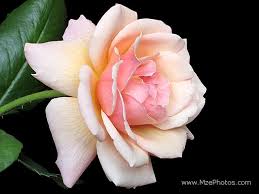
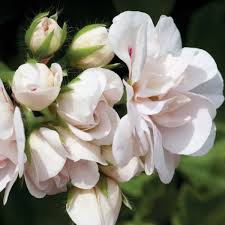
Peonies...............
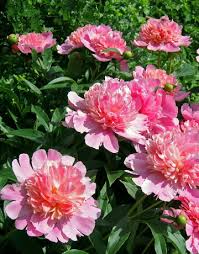
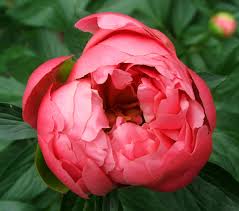
Paeonia (peony or paeony) is a genus of flowering plants, the only genus in the family Paeoniaceae. They are native to Asia, Southern Europe and Western North America. Boundaries between species are not clear and estimates of the number of species range from 25 to 40.
Peonies...............
Paeonia (peony or paeony) is a genus of flowering plants, the only genus in the family Paeoniaceae. They are native to Asia, Southern Europe and Western North America. Boundaries between species are not clear and estimates of the number of species range from 25 to 40.
Most are herbaceous perennial plants 0.5–1.5 metres (1.6–4.9 ft) tall, but some resemble trees 1.5–3 metres (4.9–9.8 ft) tall. They have compound, deeply lobed leaves and large, often fragrant, flowers, ranging from red to white or yellow, in late spring and early summer.
Kingdom: Plantae
(unranked): Angiosperms
(unranked): Eudicots
(unranked): Core eudicots
Order: Saxifragales
Family: Paeoniaceae
Genus: Paeonia
The peony is named after Paeon (also spelled Paean), a student of Asclepius, the Greek god of medicine and healing. Asclepius became jealous of his pupil; Zeus saved Paeon from the wrath of Asclepius by turning him into the peony flower.
The family name "Paeoniaceae" was first used by Friedrich K.L. Rudolphi in 1830, following a suggestion by Friedrich Gottlieb Bartling that same year. The family had been given other names a few years earlier. The composition of the family has varied, but it has always consisted of Paeonia and one or more genera that are now placed in Ranunculales. It has been widely believed that Paeonia is closest to Glaucidium, and this idea has been followed in some recent works. Molecular phylogenetic studies, however, have demonstrated conclusively that Glaucidium belongs in Ranunculaceae, but that Paeonia belongs in the unrelated order Saxifragales.

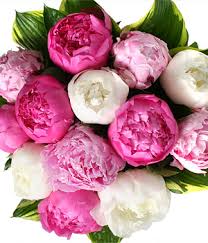
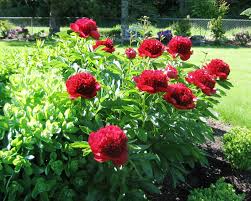
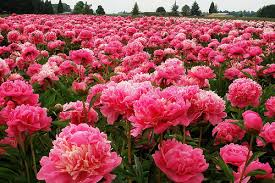
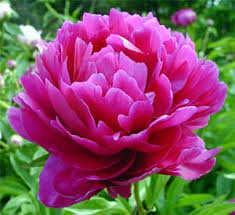
 ClassificationPeonies can be classified by both plant growth habit and flower type. Plant growth types are Herbaceous (nonwoody), Tree (shrub), and Itoh (or "Intersectional"), which is intermediate between herbaceous and tree forms. In winter herbaceous peonies die back to their underground parts, whereas tree peonies lose their leaves but retain viable woody stems above ground. The Itoh hybrids are intermediate between herbaceous and tree forms. They are named after Toichi Itoh, who first produced a successful intersectional hybrid in 1948.
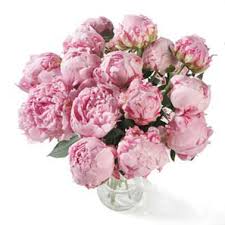
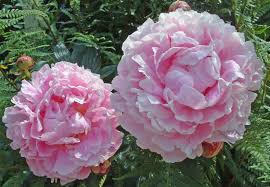
The following sequence of flower types becomes more complex in its arrangement of petals. The flower types include Single (e.g., Athena, Scarlet O’Hara), Japanese (Nippon Beauty, Madame Butterfly), Anemone, Semi-Double (Paula Fay, Buckeye Belle), Double (Gardenia, Paul M. Wild) and Bomb-Double (Raspberry Sundae, Mons Jules Elie).


Plumeria
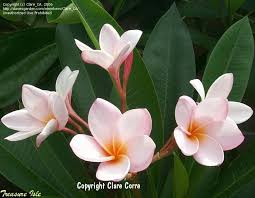
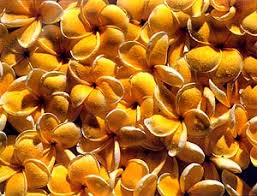
Plumeria (common name Frangipani) is a genus of flowering plants in the dogbane family, Apocynaceae. It contains seven or eight species of mainly deciduous shrubs and small trees. They are native to Central America, Mexico, the Caribbean, and South America as far south as Brazil but can be grown in tropical and sub-tropical regions.
Plumeria is related to the Oleander, Nerium oleander, and both possess an irritant, rather similar to that of Euphorbia. Contact with the sap may irritate eyes and skin. Each of the separate species of Plumeria bears differently shaped, alternate leaves with distinct form and growth habits. The leaves of P. alba are quite narrow and corrugated, whereas leaves of P. pudica have an elongated shape and glossy, dark-green color. P. pudica is one of the everblooming types with non-deciduous, evergreen leaves. Another species that retains leaves and flowers in winter is P. obtusa; though its common name is "Singapore," it is originally from Colombia.
Plumeria flowers are most fragrant at night in order to lure sphinx moths to pollinate them. The flowers have no nectar, however, and simply dupe their pollinators. The moths inadvertently pollinate them by transferring pollen from flower to flower in their fruitless search for nectar.
Plumeria species may be propagated easily from cuttings of leafless stem tips in spring. Cuttings are allowed to dry at the base before planting in well-drained soil. Cuttings are particularly susceptible to rot in moist soil.
In order to get the most of a plumeria plant, with respect to heartiness, growth, size, blooms, and scent, there is a fine line of balance that must be maintained. Ideally, a plumeria is in its element when it can have as much sun as is possible, however, it must quickly be noted that along with a long day of sun, an equal amount of water must be maintained in the soil. In other words, if a plumeria plant gets maximum sunlight and appropriate water, as to maintain soil moistness just above a state of dryness, it will flourish to its maximum potential. On the other hand, if the plant receives a lesser amount of sun, then a lesser amount of watering is necessary - again, to ensure that soil moistness stays just above the dry state. The more sun, the more water. The less sun, the less water. A common mistake of novice plumeria growers is to overwater the plant when it is not able to be exposed to so much sun as is could be, thereby resulting in a rotted root system. Conversely, if a plumeria plant is able to receive maximum exposure to the sun, but they aren't watered enough, the plant will do as all other plants that are exposed to excessive sunlight without water do - they will die. To summarize, give your plumeria as much sunlight as is possible and make sure to keep the soil just above the state of dryness.
Propagation can also be by tissue culture from cuttings of freshly elongated stems or aseptically germinated seed. Pruning is best accomplished in the winter for deciduous varieties, or when cuttings are desired.
There are more than 300 named varieties of Plumeria.
Etymology and common names
The genus, originally spelled Plumeria, is named in honor of the seventeenth-century French botanist Charles Plumier, who traveled to the New World documenting many plant and animal species. The common name "Frangipani" comes from an Italian noble family (itself literally meaning "breads-breaker(s)" in Italian), a sixteenth-century marquess who invented a plumeria-scented perfume. Many English speakers also simply use the generic name "plumeria". In India, the name is "champa" or "chafa", in Telugu "Deva ganneru" (divine nerium), in Manipuri "Khagi Layhaaw" . In Hawaii, the name is "melia" although common usage among all residents is still "plumeria". In Sri Lanka, it is referred to as araliya and (in English) as the Temple Tree. In Cantonese it is known as, 'gaai daan fa' or the 'egg yolk flower' tree. The name 'Leelawadee' (originating from Thai)[5][6] is found occasionally. In Indonesia, where the flower has been commonly associated with Balinese culture, it is known as "Kamboja".







Erica


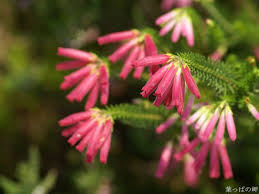
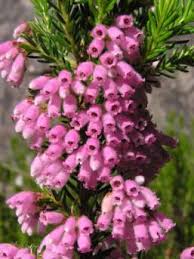
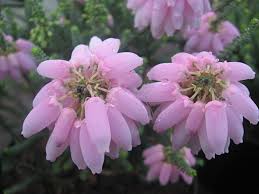
Erica is a genus of approximately 860 species of flowering plants in the family Ericaceae. The English common names "heath" and "heather" are shared by some closely related genera of similar appearance. The genus Calluna was formerly included in Erica – it differs in having even smaller scale-leaves (less than 2–3 mm long), and the flower corolla being more divided into separate petals. Erica is sometimes referred to as "winter (or spring) heather" to distinguish it from Calluna (summer (or autumn) heather)
Most of the species are small shrubs from 20–150 cm (8–59 in) high, though some are taller; the tallest are E. arborea (tree heath) and E. scoparia (besom heath), both of which can reach up to 7 m (23 ft) tall. All are evergreen, with minute needle-like leaves 2–15 mm long. Flowers are sometimes axillary, and sometimes borne in terminal umbels or spikes, and are usually outward or downward facing. The seeds are very small, and in some species may persist in the soil for decades.
Habitat
At least 660 of the species are endemic to South Africa, and these are often called the Cape heaths, forming the largest genus in the fynbos. The remaining species are native to other parts of Africa, Madagascar, the Mediterranean and Europe.
Like most Ericaceae, Erica species are mainly calcifuges, being limited to acidic or very acidic soils. In fact the term "ericaceous" is frequently applied to all calcifuges, and to the compost used in their cultivation. Soils range from dry, sandy soils to extremely wet ones such as bog. They often dominate dwarf-shrub habitats (heathland and moorland), or the ground vegetation of open acidic woodland.
Cultivation
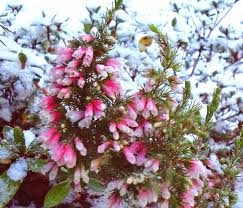
Erica species are grown as landscape or garden plants for their floral effect. They associate well with conifers and are frequently seen in planting schemes as massed groundcover beneath varieties of dwarf conifers. They are capable of producing flower colour throughout the year. They can also be grown in tubs or window boxes to provide interest through autumn and into winter.



 Roses
Roses

 Species
Banksianae - white and yellow flowered roses from China.
Bracteatae - three species, two from China and one from India.
Caninae - pink and white flowered species from Asia, Europe and North Africa.
Carolinae - white, pink, and bright pink flowered species all from North America.
Chinensis - white, pink, yellow, red and mixed-color roses from China and Burma.
Gallicanae - pink to crimson and striped flowered roses from western Asia and Europe.
Gymnocarpae - one species in western North America (Rosa gymnocarpa), others in east Asia.
Laevigatae - a single white flowered species from China
Pimpinellifoliae - white, pink, bright yellow, mauve and striped roses from Asia and Europe.
Rosa (syn. sect. Cinnamomeae) - white, pink, lilac, mulberry and red roses from everywhere but North Africa.
Synstylae - white, pink, and crimson flowered roses from all areas.
Species
Banksianae - white and yellow flowered roses from China.
Bracteatae - three species, two from China and one from India.
Caninae - pink and white flowered species from Asia, Europe and North Africa.
Carolinae - white, pink, and bright pink flowered species all from North America.
Chinensis - white, pink, yellow, red and mixed-color roses from China and Burma.
Gallicanae - pink to crimson and striped flowered roses from western Asia and Europe.
Gymnocarpae - one species in western North America (Rosa gymnocarpa), others in east Asia.
Laevigatae - a single white flowered species from China
Pimpinellifoliae - white, pink, bright yellow, mauve and striped roses from Asia and Europe.
Rosa (syn. sect. Cinnamomeae) - white, pink, lilac, mulberry and red roses from everywhere but North Africa.
Synstylae - white, pink, and crimson flowered roses from all areas.