
Thursday, August 15, 2013


Monday, July 15, 2013
List of Indian state flowers
List of Indian state flowers
State Common name Scientific name
Andhra Pradesh Nelumbo Water lily
Arunachal Pradesh Lady's Slipper Cypripedioideae
Assam Foxtail Orchids Rhynchostylis gigantea
Bihar White Orchid-tree Bauhinia acuminata
Chhattisgarh
Goa
Gujarat Marigold (Galgota) Tagetes erecta
Haryana Lotus Nelumbo nucifera
Himachal Pradesh Rhododendron Rhododendron ponticum
Jammu and Kashmir Common Rhododendron Rhododendron ponticum
Jharkhand Parrot Tree Butea monosperma
Karnataka Lotus Nelumbo nucifera
Kerala Golden Shower Tree Cassia fistula
Meghalaya Lady's Slipper Cypripedioideae
Madhya Pradesh Parrot Tree Butea monosperma
Maharashtra Jarul Lagerstroemia speciosa
Manipur Siroi Lily Lilium mackliniae
Mizoram Red Vanda
Nagaland Rhododendron Rhododendron ponticum
Odisha Ashoka Saraca asoca
Rajasthan Rohira Tecomella undulata
Sikkim Noble orchid Cymbidium goeringii
Tamil Nadu Glory lily Gloriosa superba
Tripura Nag Kesar Mesua ferrea
Uttarakhand Brahma Kamal Saussurea obvallata
Uttar Pradesh Palash Butea monosperma
West Bengal Night-flowering Jasmine


Thursday, July 11, 2013
Helianthus maximiliani (A Species of Sunflower)
Helianthus maximiliani

Helianthus maximiliani (also, H. maximilianii) is a species of sunflower known by the common name Maximilian sunflower.
Native to much of the eastern half of North America, it is found in parts of the western half as an introduced species. The plant thrives in a number of ecosystems, particularly across the plains in central Canada and the United States. It is also cultivated as an ornamental.[1]
A branching perennial herb, growing from a stout rhizome and reaches heights from one half to three meters. The lance-shaped leaves are narrow, pointed, folded down the midvein, and up to 30 centimeters long on large plants. The slender, tall, erect stems and alternately-arranged leaves are covered in rough hairs. The flower heads are surrounded at the base by pointed green phyllaries which often stick straight out and curl at the tips. The center is filled with yellow tipped brown disc florets and the circumference is lined with bright yellow ray florets 2 to 4 centimeters long.
The plant reproduces by seed and by vegetative sprouting from the rhizome. The thick rhizome is edible and provided a food similar to the Jerusalem artichoke for Native American groups such as the Sioux. The flower heads are attractive to insects and the fruits are eaten by birds. This sunflower is named for Prince Maximilian of Wied-Neuwied, who encountered it on his travels in North America.
The Land Institute, a perennial agriculture research center located in Salina, Kansas, run by Wes Jackson is experimenting with this species to create a perennial oilseed grain crop that does not necessitate replanting each season.
Kingdom: Plantae
(unranked): Angiosperms
(unranked): Eudicots
(unranked): Asterids
Order: Asterales
Family: Asteraceae
Genus: Helianthus


Jerusalem artichoke (A Species of Sunflower)
Jerusalem artichoke
The Jerusalem artichoke (Helianthus tuberosus), also called sunroot, sunchoke, earth apple or topinambour, is a species of sunflower native to eastern North America, and found from eastern Canada and Maine west to North Dakota, and south to northern Florida and Texas. It is also cultivated widely across the temperate zone for its tuber, which is used as a root vegetable.
Kingdom: Plantae
(unranked): Angiosperms
(unranked): Eudicots
(unranked): Asterids
Order: Asterales
Family: Asteraceae
Tribe: Heliantheae
Genus: Helianthus
Species: H. tuberosus
It is a herbaceous perennial plant growing to 1.5–3 metres (4 ft 10 in–9 ft 10 in) tall with opposite leaves on the lower part of the stem. The leaves have a rough, hairy texture and the larger leaves on the lower stem are broad ovoid-acute and can be up to 30 centimetres (12 in) long, and the higher leaves smaller and narrower.
The flowers are yellow and produced in capitate flowerheads, which are 5–10 centimetres (2.0–3.9 in) in diameter, with 10–20 ray florets.
The tubers are elongated and uneven, typically 7.5–10 centimetres (3.0–3.9 in) long and 3–5 centimetres (1.2–2.0 in) thick, and vaguely resembling ginger root, with a crisp texture when raw. They vary in color from pale brown to white, red or purple.
The artichoke contains about 10% protein, no oil, and a surprising lack of starch. However, it is rich in the carbohydrate inulin (76%), which is a polymer of the monosaccharide fructose. Tubers that are stored for any length of time will digest its inulin into its component fructose. Jerusalem artichokes have an underlying sweet taste because of the fructose, which is about one and a half times sweeter than sucrose.
Jerusalem artichokes have also been promoted as a healthy choice for diabetics. The reason for this being the case is because fructose is better tolerated by people that are diabetic. It has also been reported as a folk remedy for diabetes. Temperature variances have been shown to affect the amount of inulin the Jerusalem artichoke can produce. When not in tropical regions, it has been shown to make less inulin than when it is in a warmer region.


Nutritional value per 100 g (3.5 oz)
Energy 304 kJ (73 kcal)
Carbohydrates 17.44 g
- Sugars 9.6 g
- Dietary fiber 1.6 g
Fat 0.01 g
Protein 2 g
Thiamine (vit. B1) 0.2 mg (17%)
Riboflavin (vit. B2) 0.06 mg (5%)
Niacin (vit. B3) 1.3 mg (9%)
Pantothenic acid (B5) 0.397 mg (8%)
Vitamin B6 0.077 mg (6%)
Folate (vit. B9) 13 μg (3%)
Vitamin C 4 mg (5%)
Calcium 14 mg (1%)
Iron 3.4 mg (26%)
Magnesium 17 mg (5%)
Phosphorus 78 mg (11%)
Potassium 429 mg (9%)

Tithonia (A Species of Sunflower)
Tithonia
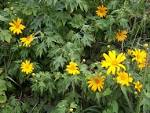

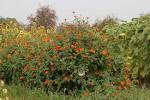
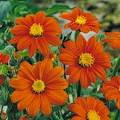

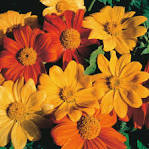
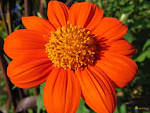
Tithonia is a genus of flowering plants in the family Asteraceae. It includes 11 species, with a center of distribution in Mexico but with one species extending into the Southwestern United States and several extending into Central America. Two species, T. diversifolia and T. rotundifolia, are widely cultivated and have escaped to become weeds in tropical and subtropical areas around the world. The distinguishing feature of the genus is the peduncle, which is fistulose (meaning hollow and flaring toward the apex). The plants are coarse annual or perennial herbs or shrubs, and one species, T. koelzii, is a small tree.
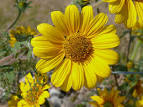

Species
Tithonia brachypappa B.L.Rob.
Tithonia calva Sch.Bip.
Tithonia diversifolia (Hemsl.) A.Gray – Tree Marigold
Tithonia fruticosa Canby & Rose
Tithonia hondurensis La Duke
Tithonia koelzii McVaugh
Tithonia longiradiata (Bertol.) S.F.Blake
Tithonia pedunculata Cronquist
Tithonia rotundifolia (Mill.) S.F.Blake
Tithonia thurberi Gray – Arizona Sunflower Weed
Tithonia tubaeformis (Jacq.) Cass.


Tithonia is a genus of flowering plants in the family Asteraceae. It includes 11 species, with a center of distribution in Mexico but with one species extending into the Southwestern United States and several extending into Central America. Two species, T. diversifolia and T. rotundifolia, are widely cultivated and have escaped to become weeds in tropical and subtropical areas around the world. The distinguishing feature of the genus is the peduncle, which is fistulose (meaning hollow and flaring toward the apex). The plants are coarse annual or perennial herbs or shrubs, and one species, T. koelzii, is a small tree.
Species
Tithonia brachypappa B.L.Rob.
Tithonia calva Sch.Bip.
Tithonia diversifolia (Hemsl.) A.Gray – Tree Marigold
Tithonia fruticosa Canby & Rose
Tithonia hondurensis La Duke
Tithonia koelzii McVaugh
Tithonia longiradiata (Bertol.) S.F.Blake
Tithonia pedunculata Cronquist
Tithonia rotundifolia (Mill.) S.F.Blake
Tithonia thurberi Gray – Arizona Sunflower Weed
Tithonia tubaeformis (Jacq.) Cass.
Subscribe to:
Posts (Atom)