Jasmine
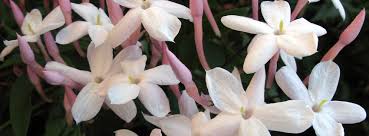
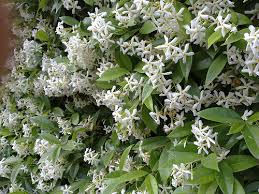
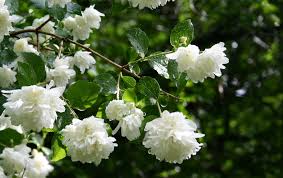
Jasmine (taxonomic name Jasminum is a genus of shrubs and vines in the olive family (Oleaceae). It contains around 200 species native to tropical and warm temperate regions of the Old World. Jasmines are widely cultivated for the characteristic fragrance of their flowers.
Kingdom: Plantae
(unranked): Angiosperms
(unranked): Eudicots
(unranked): Asterids
Order: Lamiales
Family: Oleaceae
Tribe: Jasmineae
Genus: Jasminum
Jasmines can be either deciduous (leaves falling in autumn) or evergreen (green all year round), and can be erect, spreading, or climbing shrubs and vines. Their leaves are borne opposite or alternate. They can be simple, trifoliate, or pinnate. The flowers are typically around 2.5 cm (0.98 in) in diameter. They are white or yellow in color, although in rare instances they can be slightly reddish. The flowers are borne in cymose clusters with a minimum of three flowers, though they can also be solitary on the ends of branchlets. Each flower has about four to nine petals, two locules, and one to four ovules. They have two stamens with very short filaments. The bracts are linear or ovate. The calyx is bell-shaped. They are usually very fragrant. The fruits of jasmines are berries that turn black when ripe.
Jasmine tea
Green tea with jasmine flowers
Jasmine tea is consumed in China, where it is called jasmine-flower tea (茉莉花茶; pinyin: mò lì huā chá). Jasminum sambac flowers are also used to make jasmine tea, which often has a base of green tea, but sometimes an Oolong base is used. Flowers and tea are "mated" in machines that control temperature and humidity. It takes four hours or so for the tea to absorb the fragrance and flavour of the jasmine blossoms, and for the highest grades, this process may be repeated as many as seven times. Because the tea has absorbed moisture from the flowers, it must be refired to prevent spoilage. The spent flowers may or may not be removed from the final product, as the flowers are completely dry and contain no aroma. Giant fans are used to blow away and remove the petals from the denser tea leaves. If present, they simply add visual appeal and are no indication of the quality of the tea.
In Okinawa, Japan, jasmine tea is known as sanpin cha.
Jasmine syrup
Jasmine syrup, made from jasmine flowers, is used as a flavouring.
Jasmine essential oil
Jasmine is considered an absolute and not an essential oil as the petals of the flower are much too delicate and would be destroyed by the distillation process used in creating essential oils. Other than the processing method it is essentially the same as an essential oil. Absolute is a technical term used to denote the process of extraction. It is in common use. Its flowers are either extracted by the labour-intensive method of enfleurage or through chemical extraction. It is expensive due to the large number of flowers needed to produce a small amount of oil. The flowers have to be gathered at night because the odour of jasmine is more powerful after dark. The flowers are laid out on cotton cloths soaked in olive oil for several days and then extracted leaving the true jasmine essence. Some of the countries producing jasmine essential oil are India, Egypt, China and Morocco.
Jasmine absolute used in perfume and incense
Jasmine (Jasminum officinale) absolute in a clear glass vial
Many species also yield an absolute, which is used in perfumes and incense. Its chemical constituents include methyl anthranilate, indole, benzyl alcohol, linalool, and skatole.
Jasmonates
Jasmonate
Jasmine gave name to the jasmonate plant hormones as methyl jasmonate isolated from the jasmine oil of Jasminum grandiflorum led to the discovery of the molecular structure of jasmonates.


Morphology
A stereotypical flower consists of four kinds of structures attached to the tip of a short stalk. Each of these kinds of parts is arranged in a whorl on the receptacle. The four main whorls (starting from the base of the flower or lowest node and working upwards) are as follows:
Calyx: the outermost whorl consisting of units called sepals; these are typically green and enclose the rest of the flower in the bud stage, however, they can be absent or prominent and petal-like in some species.
Corolla: the next whorl toward the apex, composed of units called petals, which are typically thin, soft and colored to attract animals that help the process of pollination.
Androecium (from Greek andros oikia: man's house): the next whorl (sometimes multiplied into several whorls), consisting of units called stamens. Stamens consist of two parts: a stalk called a filament, topped by an anther where pollen is produced by meiosis and eventually dispersed.
Gynoecium (from Greek gynaikos oikia: woman's house): the innermost whorl of a flower, consisting of one or more units called carpels. The carpel or multiple fused carpels form a hollow structure called an ovary, which produces ovules internally. Ovules are megasporangia and they in turn produce megaspores by meiosis which develop into female gametophytes. These give rise to egg cells. The gynoecium of a flower is also described using an alternative terminology wherein the structure one sees in the innermost whorl (consisting of an ovary, style and stigma) is called a pistil. A pistil may consist of a single carpel or a number of carpels fused together. The sticky tip of the pistil, the stigma, is the receptor of pollen. The supportive stalk, the style, becomes the pathway for pollen tubes to grow from pollen grains adhering to the stigma.
Although the arrangement described above is considered "typical", plant species show a wide variation in floral structure. These modifications have significance in the evolution of flowering plants and are used extensively by botanists to establish relationships among plant species.
Christmas Lily (Lilium longiflorum).
1. Stigma
2. Style
3. Stamens
4. Filament
5. Petal
The four main parts of a flower are generally defined by their positions on the receptacle and not by their function. Many flowers lack some parts or parts may be modified into other functions and/or look like what is typically another part. In some families, like Ranunculaceae, the petals are greatly reduced and in many species the sepals are colorful and petal-like. Other flowers have modified stamens that are petal-like, the double flowers of Peonies and Roses are mostly petaloid stamens. Flowers show great variation and plant scientists describe this variation in a systematic way to identify and distinguish species.
Specific terminology is used to describe flowers and their parts. Many flower parts are fused together; fused parts originating from the same whorl are connate, while fused parts originating from different whorls are adnate, parts that are not fused are free. When petals are fused into a tube or ring that falls away as a single unit, they are sympetalous (also called gamopetalous.) Connate petals may have distinctive regions: the cylindrical base is the tube, the expanding region is the throat and the flaring outer region is the limb. A sympetalous flower, with bilateral symmetry with an upper and lower lip, is bilabiate. Flowers with connate petals or sepals may have various shaped corolla or calyx including: campanulate, funnelform, tubular, urceolate, salverform or rotate.
Many flowers have a symmetry. When the perianth is bisected through the central axis from any point, symmetrical halves are produced, forming a radial symmetry. These flowers are also known to be actinomorphic or regular, e.g. rose or trillium. When flowers are bisected and produce only one line that produces symmetrical halves the flower is said to be irregular or zygomorphic, e.g. snapdragon or most orchids.
Flowers may be directly attached to the plant at their base (sessile—the supporting stalk or stem is highly reduced or absent). The stem or stalk subtending a flower is called a peduncle. If a peduncle supports more than one flower, the stems connecting each flower to the main axis are called pedicels. The apex of a flowering stem forms a terminal swelling which is called the torus or receptacle.
Floral formula


Hibiscus
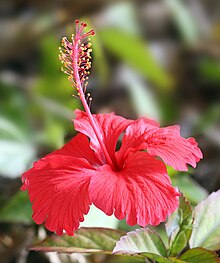
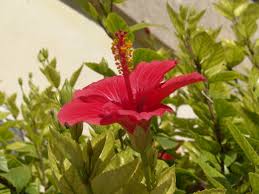
Hibiscus is a genus of flowering plants in the mallow family, Malvaceae. It is quite large, containing several hundred species that are native to warm-temperate, subtropical and tropical regions throughout the world. Member species are often noted for their showy flowers and are commonly known simply as hibiscus, or less widely known as rose mallow. The genus includes both annual and perennial herbaceous plants, as well as woody shrubs and small trees. The generic name is derived from the Greek word (hibískos), which was the name Pedanius Dioscorides (ca. 40–90) gave to Althaea officinalis.


Kingdom: Plantae
Division: Angiosperms
Class: Eudicots
Order: Malvales
Family: Malvaceae
Subfamily: Malvoideae
Tribe: Hibisceae
Genus: Hibiscus



General nature of leaves
Typically leaves are flat and thin, thereby maximising the surface area directly exposed to light and promoting photosynthetic function. Externally they commonly are arranged on the plant in such ways as to expose their surfaces to light as efficiently as possible without shading each other, but there are many exceptions and complications; for instance plants adapted to windy conditions may have pendent leaves, such as in many willows and Eucalyptus.
Likewise, the internal organisation of most kinds of leaves has evolved to maximise exposure of the photosynthetic organelles, the chloroplasts, to light and to increase the absorption of carbon dioxide. Most leaves have stomata, which open or narrow to regulate the exchange of carbon dioxide, oxygen, and water vapour with the atmosphere.
In contrast however, some leaf forms are adapted to modulate the amount of light they absorb to avoid or mitigate excessive heat, ultraviolet damage, or desiccation, or to sacrifice light-absorption efficiency in favour of protection from herbivorous enemies. Among these forms the leaves of many xerophytes are conspicuous. For such plants their major constraint is not light flux or intensity, but heat, cold, drought, wind, herbivory, and various other hazards. Typical examples among such strategies are so-called window plants such as Fenestraria species, some Haworthia species such as Haworthia tesselata and Haworthia truncata and Bulbine mesembryanthemoides.
The shape and structure of leaves vary considerably from species to species of plant, depending largely on their adaptation to climate and available light, but also to other factors such as grazing animals, available nutrients, and ecological competition from other plants. Considerable changes in leaf type occur within species too, for example as a plant matures; as a case in point Eucalyptus species commonly have isobilateral, pendent leaves when mature and dominating their neighbours; however, such trees tend to have erect or horizontal dorsiventral leaves as seedlings, when their growth is limited by the available light. Other factors include the need to balance water loss at high temperature and low humidity against the need to absorb atmospheric carbon dioxide. In most plants leaves also are the primary organs responsible for transpiration and guttation (beads of fluid forming at leaf margins).
Leaves can also store food and water, and are modified accordingly to meet these functions, for example in the leaves of succulent plants and in bulb scales. The concentration of photosynthetic structures in leaves requires that they be richer in protein, minerals, and sugars, than say, woody stem tissues. Accordingly leaves are prominent in the diet of many animals. This is true for humans, for whom leaf vegetables commonly are food staples.
A leaf shed in autumn.
Correspondingly, leaves represent heavy investment on the part of the plants bearing them, and their retention or disposition are the subject of elaborate strategies for dealing with pest pressures, seasonal conditions, and protective measures such as the growth of thorns and the production of phytoliths, lignins, tannins and poisons.
Deciduous plants in frigid or cold temperate regions typically shed their leaves in autumn, whereas in areas with a severe dry season, some plants may shed their leaves until the dry season ends. In either case the shed leaves may be expected to contribute their retained nutrients to the soil where they fall.
In contrast, many other non-seasonal plants, such as palms and conifers, retain their leaves for long periods; Welwitschia retains its two main leaves throughout a lifetime that may exceed a thousand years.
Not all plants have true leaves. Bryophytes (e.g., mosses and liverworts) are non-vascular plants, and, although they produce flattened, leaf-like structures that are rich in chlorophyll, these organs differ morphologically from the leaves of vascular plants; For one thing, they lack vascular tissue. Vascularised leaves first evolved following the Devonian period, when carbon dioxide concentration in the atmosphere dropped significantly. This occurred independently in two separate lineages of vascular plants: the microphylls of lycophytes and the euphylls ("true leaves") of ferns, gymnosperms, and angiosperms. Euphylls are also referred to as macrophylls or megaphylls ("large leaves").


