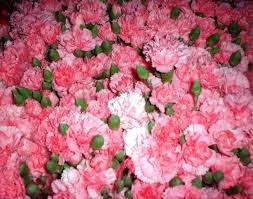
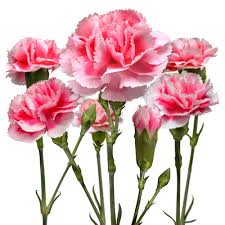
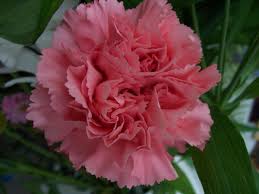
carnation flowers


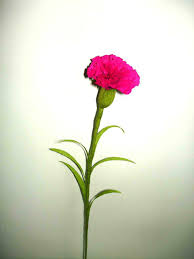
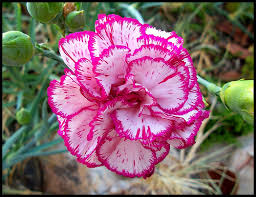
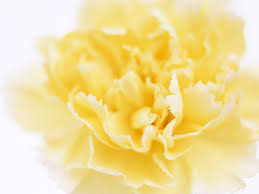 Dianthus caryophyllus, carnation or clove pink, is a species of Dianthus. It is probably native to the Mediterranean region but its exact range is unknown due to extensive cultivation for the last 2,000 years.
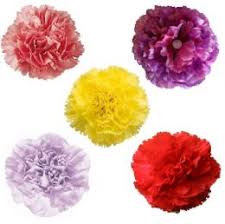
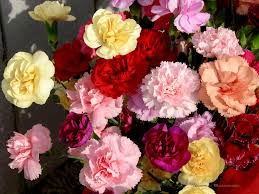
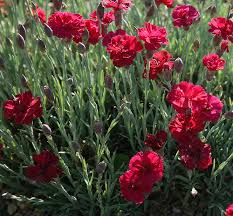
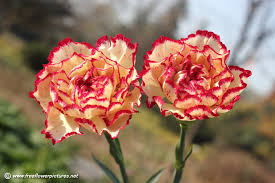
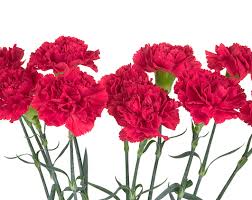
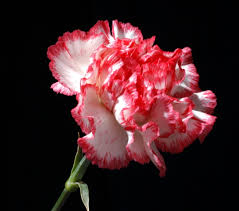
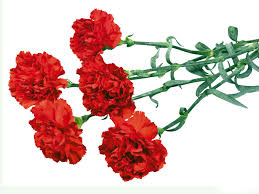
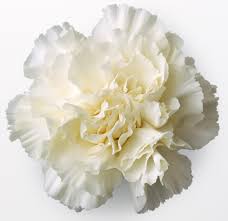
It is a herbaceous perennial plant growing to 80 cm tall. The leaves are glaucous greyish green to blue-green, slender, up to 15 cm long. The flowers are produced singly or up to five together in a cyme; they are 3–5 cm diameter, and sweetly scented; the original natural flower colour is bright pinkish-purple, but cultivars of other colours, including red, white, yellow and green, have been developed.
Kingdom: Plantae
(unranked): Angiosperms
(unranked): Eudicots
(unranked): Core eudicots
Order: Caryophyllales
Family: Caryophyllaceae
Genus: Dianthus
Species: D. caryophyllus
Growing carnations
Carnations require well-drained, neutral to slightly alkaline soil, and full sun. Numerous cultivars have been selected for garden planting. Typical examples include 'Gina Porto', 'Helen', 'Laced Romeo', and 'Red Rocket'.
Colombia is the largest carnation producer in the world.
Colors
Carnations do not naturally produce the pigment delphinidin, thus a blue carnation cannot occur by natural selection or be created by traditional plant breeding. It shares this characteristic with other widely sold flowers like roses, lilies, tulips, chrysanthemums and gerberas.
Around 1996 a company, Florigene, used genetic engineering to extract certain genes from petunia and snapdragon flowers to produce a blue-mauve carnation, which was commercialized as Moondust. In 1998 a violet carnation called Moonshadow was commercialized. As of 2004 three additional blue-violet/purple varieties have been commercialized.
Carnations were mentioned in Greek literature 2,000 years ago. "Dianthus" was coined by Greek botanist Theophrastus, and is derived from the Greek words for divine ("dios") and flower ("anthos"). Some scholars believe that the name "carnation" comes from "coronation" or "corone" (flower garlands), as it was one of the flowers used in Greek ceremonial crowns. Others think the name stems from the Latin "caro" (genitive "carnis") (flesh), which refers to the original colour of the flower, or incarnatio (incarnation), which refers to the incarnation of God made flesh.
Although originally applied to the species Dianthus caryophyllus, the name Carnation is also often applied to some of the other species of Dianthus, and more particularly to garden hybrids between D. caryophyllus and other species in the genus.








Coconut Flowers
The coconut palm (also, cocoanut), Cocos nucifera, is a member of the family Arecaceae (palm family). It is the only accepted species in the genus Cocos. The term coconut can refer to the entire coconut palm, the seed, or the fruit, which, botanically, is a drupe, not a nut. The spelling cocoanut is an archaic form of the word. The term is derived from 16th-century Portuguese and Spanish coco, meaning "head" or "skull", from the three small holes on the coconut shell that resemble human facial features.
Found throughout the tropic and subtropic area, the coconut is known for its great versatility as seen in the many domestic, commercial, and industrial uses of its different parts. Coconuts are part of the daily diets of many people. Coconuts are different from any other fruits because they contain a large quantity of "water" and when immature they are known as tender-nuts or jelly-nuts and may be harvested for drinking. When mature, they still contain some water and can be used as seednuts or processed to give oil from the kernel, charcoal from the hard shell and coir from the fibrous husk. The endosperm is initially in its nuclear phase suspended within the coconut water. As development continues, cellular layers of endosperm deposit along the walls of the coconut, becoming the edible coconut "flesh". When dried, the coconut flesh is called copra. The oil and milk derived from it are commonly used in cooking and frying; coconut oil is also widely used in soaps and cosmetics. The clear liquid coconut water within is a refreshing drink. The husks and leaves can be used as material to make a variety of products for furnishing and decorating. It also has cultural and religious significance in many societies that use it.


 Kingdom: Plantae
Class: Monocots
Order: Arecales
Suborder: Commelinids
Family: Arecaceae
Subfamily: Arecoideae
Tribe: Cocoeae
Genus: Cocos
Species: C. nucifera


Tomato Flowers
The tomato is the edible, often red fruit of the plant Solanum lycopersicum, commonly known as a tomato plant. Both the species and its use as a food originated in Mexico, and spread around the world following the Spanish colonization of the Americas. Its many varieties are now widely grown, sometimes in greenhouses in cooler climates.
The tomato is consumed in diverse ways, including raw, as an ingredient in many dishes, sauces, salads, and drinks. While it is botanically a fruit, it is considered a vegetable for culinary purposes (as well as by the United States Supreme Court, see Nix v. Hedden), which has caused some confusion. The fruit is rich in lycopene, which may have beneficial health effects.
The tomato belongs to the nightshade family. The plants typically grow to 1–3 meters (3–10 ft) in height and have a weak stem that often sprawls over the ground and vines over other plants. It is a perennial in its native habitat, although often grown outdoors in temperate climates as an annual. An average common tomato weighs approximately 100 grams.


 Kingdom: Plantae
(unranked): Angiosperms
Division: Magnoliophyta
(unranked): Eudicots
Class: Magnoliopsida
(unranked): Asterids
Order: Solanales
Family: Solanaceae
Subfamily: Solanoideae
Tribe: Solaneae
Genus: Solanum
Species: S. lycopersicum

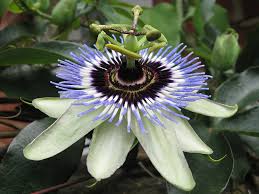
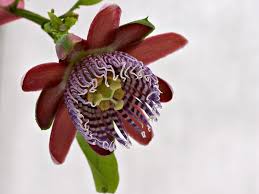
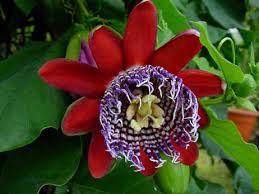
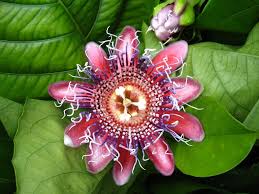
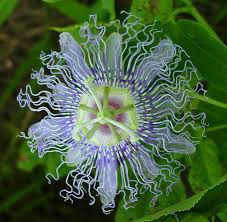
Passiflora
Passiflora, known also as the passion flowers or passion vines, is a genus of about 500 species of flowering plants, the namesakes of the family Passifloraceae. They are mostly vines, with some being shrubs, and a few species being herbaceous. For information about the fruit of the passiflora plant, see passionfruit. The monotypic genus Hollrungia seems to be inseparable from Passiflora, but further study is needed.
Kingdom: Plantae
(unranked): Angiosperms
(unranked): Eudicots
(unranked): Rosids
Order: Malpighiales
Family: Passifloraceae
Genus: Passiflora


Distribution
The family Passifloraceae has a pantropical distribution. Passiflora itself is absent from Africa, where many other members of the family Passifloraceae occur (e.g. the more plesiomorphic Adenia).
Nine species of Passiflora are native to the USA, found from Ohio to the north, west to California and south to the Florida Keys. Most other species are found in South America, Eastern Asia, and Southern Asia, New Guinea, four or more species in Australia and a single endemic species in New Zealand. New species continue to be identified: for example, P. pardifolia and P. xishuangbannaensis have only been known to the scientific community since 2006 and 2005, respectively.
Some species of Passiflora have been naturalised beyond their native ranges. For example, Blue Passion Flower (P. caerulea) now grows wild in Spain. The purple passionfruit (P. edulis) and its yellow relative flavicarpa have been introduced in many tropical regions as commercial crops.