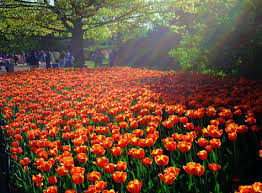
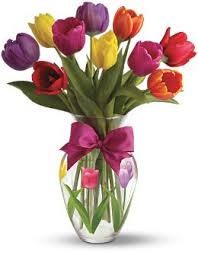
The tulip is a perennial, bulbous plant with showy flowers in the genus Tulipa, of which up to 109 species have been described and which belongs to the family Liliaceae. The genus's native range extends from as far west as Southern Europe, Anatolia (Turkey), Israel, Palestine, North Africa, and Iran to the Northwest of China. The tulip's centre of diversity is in the Pamir, Hindu Kush, and Tien Shan mountains. A number of species and many hybrid cultivars are grown in gardens, as potted plants, or to be displayed as fresh-cut flowers. Most cultivars of tulip are derived from Tulipa gesneriana.
Kingdom: Plantae
Division: Angiosperms
Order: Liliales
Family: Liliaceae
Subfamily: Lilioideae
Genus: Tulipa

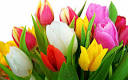


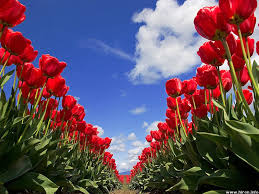
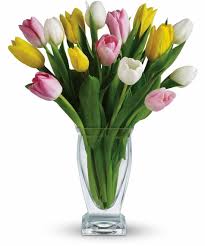 CultivationTulips are indigenous to mountainous areas with temperate climates and need a period of cool dormancy, known as vernalization. They thrive in climates with long, cool springs and dry summers. Although perennials, tulip bulbs are often imported to warm-winter areas of the world from cold-winter areas, and are planted in the fall to be treated as annuals.
Tulip bulbs are typically planted around late summer and fall, in well-drained soils, normally from 4 inches (10 cm) to 8 inches (20 cm) deep, depending on the type planted. In parts of the world that do not have long cool springs and dry summers, the bulbs are often planted up to 12 inches (30 cm) deep. This provides some insulation from the heat of summer, and tends to encourage the plants to regenerate one large, floriferous bulb each year, instead of many smaller, non-blooming ones.[citation needed] This can extend the life of a tulip plant in warmer-winter areas by a few years, but it does not stave off degradation in bulb size and the eventual death of the plant due to the lack of vernalization.



Bougainvillea
Bougainvillea also known as Napoleón (Honduras), veranera (Colombia, Nicaragua, El Salvador, Costa Rica and Panama), trinitaria (Colombia, Cuba, Panama, Puerto Rico, Dominican Republic & Venezuela), Santa Rita (Argentina, Bolivia, Paraguay and Uruguay) or papelillo (northern Peru)) is a genus of flowering plants native to South America from Brazil west to Perú and south to southern Argentina (Chubut Province). Different authors accept between four and 18 species in the genus.
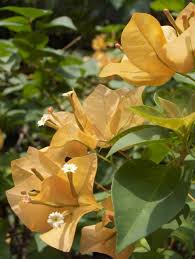
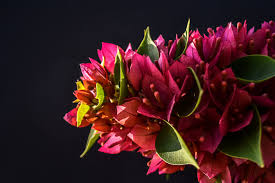
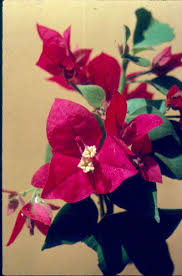
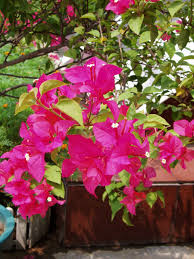
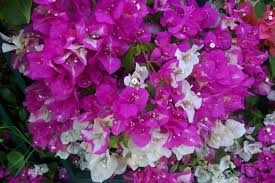
They are thorny, woody vines growing anywhere from 1 to 12 metres (3 ft 3 in to 39 ft 4 in) tall, scrambling over other plants with their spiky thorns. The thorns are tipped with a black, waxy substance. They are evergreen where rainfall occurs all year, or deciduous if there is a dry season. The leaves are alternate, simple ovate-acuminate, 4–13 cm long and 2–6 cm broad. The actual flower of the plant is small and generally white, but each cluster of three flowers is surrounded by three or six bracts with the bright colours associated with the plant, including pink, magenta, purple, red, orange, white, or yellow. Bougainvillea glabra is sometimes referred to as "paper flower" because the bracts are thin and papery. The fruit is a narrow five-lobed achene.
Bougainvillea are relatively pest-free plants, but may suffer from worms, snails and aphids. The larvae of some Lepidoptera species also use them as food plants, for example the giant leopard moth (Hypercompe scribonia).


Kingdom: Plantae
(unranked): Angiosperms
(unranked): Eudicots
(unranked): Core eudicots
Order: Caryophyllales
Family: Nyctaginaceae
Tribe: Bougainvilleeae
Genus: Bougainvillea
History
The first European to describe these plants was Philibert Commerçon, a French botanist accompanying French Navy admiral and explorer Louis Antoine de Bougainville during his voyage of circumnavigation, and first published for him by Antoine Laurent de Jussieu in 1789. It is possible that the first European to observe these plants was Jeanne Baré, Commerçon's lover and assistant whom he sneaked on board (despite regulations) disguised as a man (and who thus became the first woman to circumnavigate the globe).
Twenty years after Commerçon's discovery, it was first published as 'Buginvillea' in Genera Plantarum by A.L. de Jusseau in 1789. The genus was subsequently spelt in several ways until it was finally corrected to 'Bougainvillea' in the Index Kewensis in the 1930s. Originally, B. spectabilis and B. glabra were hardly differentiated until the mid-1980s when botanists recognized them to be totally distinct species. In the early 19th century, these two species were the first to be introduced into Europe, and soon, nurseries in France and England did a thriving trade providing specimens to Australia and other faraway countries. Meanwhile, Kew Gardens distributed plants it had propagated to British colonies throughout the world. Soon thereafter, an important event in the history of bougainvillea took place with the discovery of a crimson specimen in Cartagena, Colombia, by Mrs. R.V. Butt. Originally thought to be a distinct species, it was named B. buttiana in her honour. However, it was later discovered to be a natural hybrid of a variety of B. glabra and possibly B. peruviana - a "local pink bougainvillea" from Peru. Natural hybrids were soon found to be common occurrences all over the world. For instance, around the 1930s, when the three species were grown together, many hybrid crosses were created almost spontaneously in East Africa, India, the Canary Islands, Australia, North America, and the Philippines.


Cultivation and uses
Bougainvilleas are popular ornamental plants in most areas with warm climates. Locarno in Switzerland, with its mild Mediterranean climate, is famous for its bougainvilleas.[citation needed]
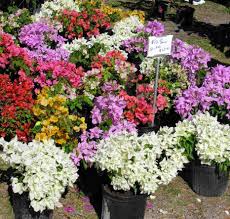
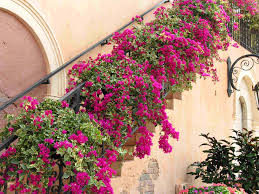
Although it is frost-sensitive and hardy in U.S. Hardiness Zones 9b and 10, bougainvillea can be used as a houseplant or hanging basket in cooler climates. In the landscape, it makes an excellent hot season plant, and its drought tolerance makes it ideal for warm climates year-round. Its high salt tolerance makes it a natural choice for color in coastal regions. It can be pruned into a standard, but is also grown along fence lines, on walls, in containers and hanging baskets, and as a hedge or an accent plant. Its long arching thorny branches bear heart-shaped leaves and masses of papery bracts in white, pink, orange, purple, and burgundy. Many cultivars, including double-flowered and variegated, are available.
Many of today's bougainvillea are the result of interbreeding among only three out of the eighteen South American species recognized by botanists. Currently, there are over 300 varieties of bougainvillea around the world. Because many of the hybrids have been crossed over several generations, it is difficult to identify their respective origins. Natural mutations seem to occur spontaneously throughout the world; wherever large numbers of plants are being produced, bud-sports will occur. This had led to multiple names for the same cultivar (or variety) and has added to the confusion over the names of bougainvillea cultivars.
The growth rate of bougainvilleas varies from slow to rapid, depending on the variety. They tend to flower all year round in equatorial regions. Elsewhere, they are seasonal, with bloom cycles typically four to six weeks. Bougainvilleas grow best in dry soil in very bright full sun and with frequent fertilization; but they require little water once established, and in fact will not flourish if over-watered. As indoor houseplants in temperate regions, they can be kept small by bonsai techniques. They can be easily propagated via tip cuttings.
The hybrid cultivar B. buttiana 'Poulton's Special' has gained the Royal Horticultural Society's Award of Garden Merit.